

Heat Resilience
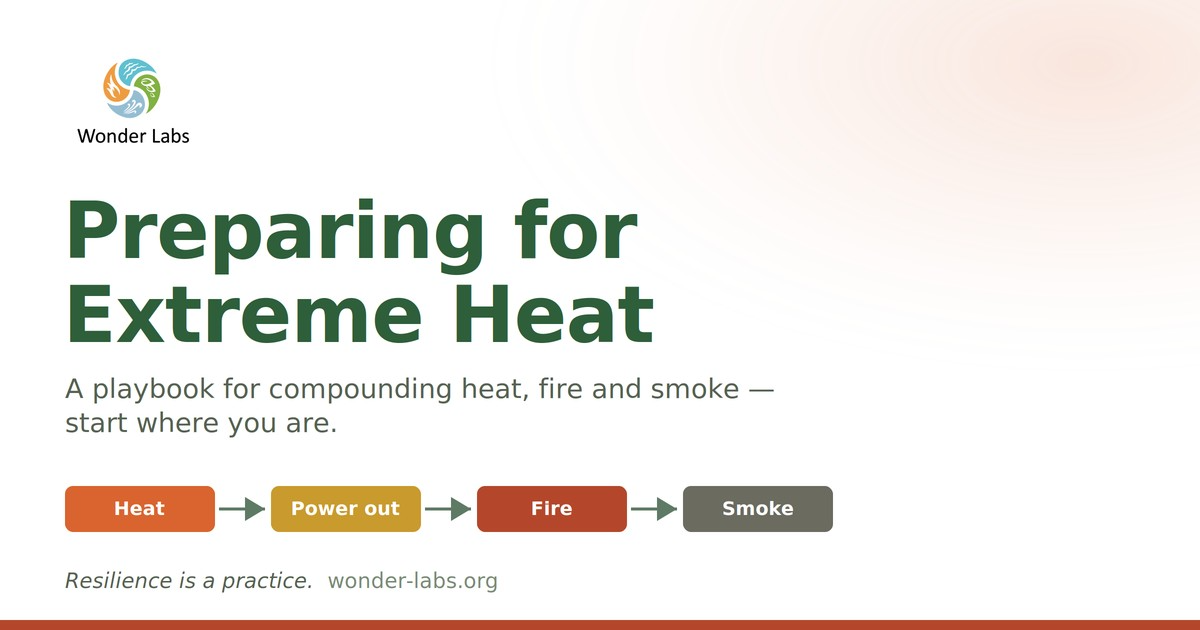
A free Wonder Labs playbook for compound heat, fire and smoke — preparing for cascading hazards and compounding disasters.
Preparing for Extreme Heat
Extreme heat is the deadliest climate hazard in the United States, and it rarely arrives alone. A heat wave strains the grid, a power shutoff or an ignition follows, and smoke settles over the same communities already struggling to stay cool.
The Heat Resilience Playbook is a free, practical guide for the places with the least room to absorb that shock — small towns, rural counties and agricultural regions — on how to prepare for compounding and cascading hazards, starting with what they already have.
⬇ Download the Heat Resilience Playbook (PDF)
Why compound heat, fire and smoke break most plans
Most local plans are written for one hazard at a time — a community wildfire protection plan, a heat advisory, a smoke management plan — and they quietly assume the others aren't happening at once. Compounding and cascading events break that assumption.
Cascading hazards form a chain. Extreme heat forces the grid, an outage and cured fuels set up an ignition, the fire brings smoke — one hazard triggers the next.
Compounding hazards pile up. At the peak, a community must cool people and shield them from smoke at the same time, on a grid that is already down.
Most real events are both: a cascade that ends in a pile-up. The playbook is built to help you plan for the whole chain, not one link at a time.
What's inside the playbook
The playbook distills a method Wonder Labs developed with San Benito County, California into six principles and a one-day tabletop exercise any community can run:
Plan for the cascade, not one hazard — trace how heat sets off grid failure, fire and smoke.
Read risk beyond the thermometer — find who is truly at risk using free, public data.
Find where your cascade lives — resolve the conflict when cooling centers and clean-air centers compete for the same buildings and power.
Plan for green and blue infrastructure — nature-based solutions that lower the baseline heat-and-fire load.
Build the human infrastructure of care — the trusted messengers and local capacity that carry help the last mile.
Assign the work to who already owns it — match each part of the plan to the partner whose mandate covers it.
It closes with a ten-step starter checklist and a lean recipe for the highest-value, lowest-cost first step a resource-strapped community can take: a compound heat-fire-smoke tabletop exercise.
Built for low-resource and rural communities
The communities most exposed to extreme heat are often the ones with the least capacity to plan for it — short on staff, budget and dedicated heat planning, with the people most at risk least visible in the data. California's own 2026 Extreme Heat Action Plan concedes the reason this is hard: local, regional and tribal governments have historically lacked the information and financial resources to plan comprehensive heat interventions. The playbook is built to close that gap, drawing on Wonder Labs' compound heat-fire-smoke work for San Benito County — a rural, farmworker county where heat, Diablo Range fire, smoke and grid failure can all land in a single week.
Work with Wonder Labs
The framework is free, and many communities will run with it on their own. When a community wants a partner to carry the load, Wonder Labs works alongside local agencies as a technical-assistance provider — capacity, not substitution. We design and facilitate compound heat-fire-smoke tabletop exercises, build the risk assessment and materials, and help identify and pursue the funding that fits, with your agency as applicant of record.
Work with us to bring extreme heat resilience to your community.
Resources
Heat Resilience Playbook: Planning for Cascading Hazards and Compounding Disasters. Wonder Labs, September 2026.
Building Heat, Wildfire, and Smoke Resilience in San Benito County, CA: A Situation Manual Drafted for the NOAA Heat Tabletop Exercise Design Challenge 2026. August 2026.
The El Niño Hazard Board and Heat Action Brief. September 2026. Updated weekly.